
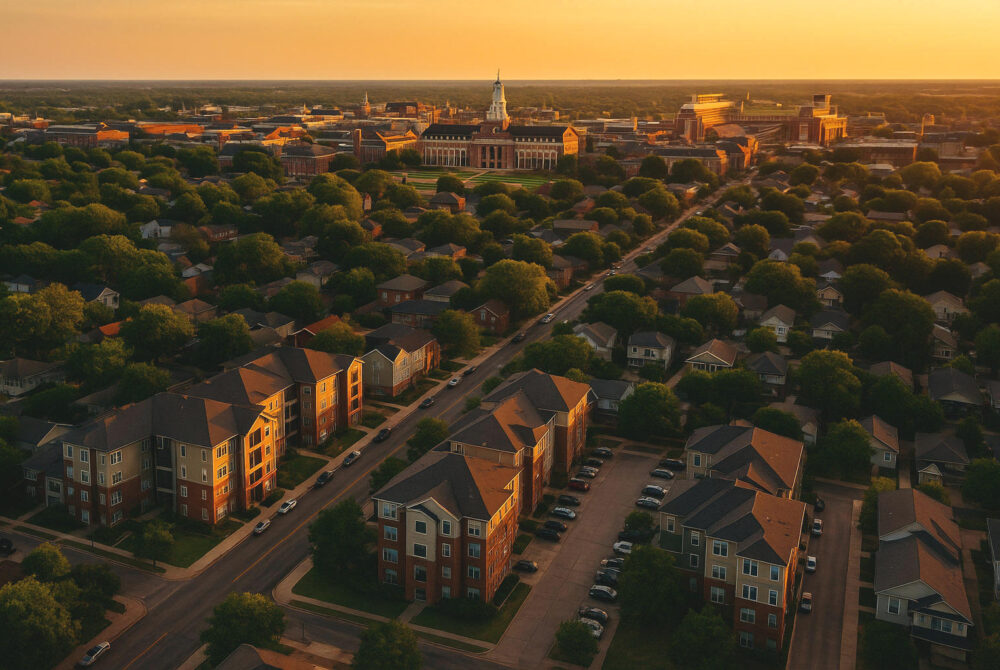
Here’s the thing about finding the best places to invest in real estate in Stillwater Oklahoma, everyone’s chasing the same orange-and-black pot of gold near the OSU campus, but the smartest investors already know where the real money lives. While amateur landlords duke it out for overpriced properties on Duck Street , savvy investors are quietly banking consistent returns in the near campus area and downtown Stillwater.
These areas aren’t your typical “college rentals are hot” story, that’s as obvious as predicting thunderstorms in May. They operate on an entirely different wavelength, where student housing meets steady appreciation, and where your investment property practically manages itself thanks to built-in demand that’s stronger than free pizza at a campus event.
Understanding why this specific pocket of Stillwater dominates rental returns requires looking beyond the obvious allure of game-day foot traffic and diving into the economics that make certain blocks absolute cash cows while others struggle to break even. Let’s explore why smart money follows the Cowboys, just not always where you’d expect.
Why Downtown Stillwater Dominates Rental Returns
Downtown Stillwater, isn’t just another college neighborhood ,it’s an economic ecosystem where supply and demand dance to a rhythm set by academic calendars and parent checkbooks. While most investors fixate on proximity to campus, the real magic happens in understanding which proximity matters.
Oklahoma State’s 25,000+ students create demand, sure, but the profitable patterns emerge when you track where graduate students, international scholars, and young faculty actually choose to live. These renters, not the stereotypical undergrads, drive the most consistent returns in and near Downtown Stillwater. Nationally, graduate and international students are associated with higher housing stability. Studies show international students in the U.S. are more likely to sign 12‑month leases compared to undergraduates, reducing vacancy risk for landlords They sign longer leases, pay on time, and treat properties like homes rather than party venues (National Multifamily Housing Council).
The sweet spot sits between Knoblock Street and Miller Avenue, where multi-family properties command premium rents without the headaches of managing a house full of nineteen-year-olds discovering freedom for the first time. Properties here maintain 95% occupancy rates year-round, not just during the school year, because they attract the university’s permanent workforce alongside serious students.
Cash-on-Cash Returns: The Multi-Family Advantage
Here’s what separates amateur hour from professional investing in Stillwater: understanding that multi-family properties in strategic locations consistently outperform single-family homes when it comes to cash flow and overall returns. Smart investors focus on properties near Oklahoma State University and downtown corridors where demand stays strong year-round, while beginners chase single-family homes in outlying areas that struggle to generate meaningful returns.
This aligns with broader industry findings: professionally managed small multifamily properties often outperform single‑family investments because of lower per-unit operating costs and reduced vacancy risk (FreedieMac). The math isn’t complicated: four units under one roof means shared maintenance costs, single insurance policies, and economies of scale that single-family landlords can’t touch.
For example, a duplex on Washington Street purchased for $180,000 can generate around $2,200 monthly in combined rents. After accounting for property management (because smart investors value their time), maintenance reserves, and Oklahoma’s property taxes, that’s potentially a significant $1,400 monthly net.
Maintenance Reality Check: Students vs. Professionals
The maintenance cost differential between student housing and professional rentals tells a story most investors learn the hard way. Student properties can require up to 40% higher maintenance budgets. Industry surveys back this up: student rentals typically command management fees 10–15% higher than conventional rentals because of the faster turnover and increased maintenance needs (This is not because students are inherently destructive, but because high turnover means more wear, more repainting, and more “my roommate’s friend’s dog ate the drywall” situations.
Professional rentals near campus, particularly those housing university staff and graduate students, flip this script entirely. Turnover can drop to once every 2-3 years versus semesterly chaos. These tenants install their own shelving, maintain gardens, and actually report maintenance issues before they become disasters. The Downtown Stillwater area mix allows investors to choose their own adventure: higher returns with higher headaches, or steadier income with fewer midnight calls.
Stillwater Hidden Gem Neighborhoods Where Property Values Are Surging

Stillwater’s real growth stories are written in infrastructure spending and demographic shifts, not wishful thinking.
The Perkins Road Corridor Revolution
While everyone fights over campus-adjacent properties, the Perkins Road corridor quietly transformed from farmland and scattered developments into Stillwater’s next investment frontier. The completion of major retail developments and the expansion of medical facilities along this stretch created a new economic center that doesn’t depend on university enrollment.
Properties here appreciate at rates that embarrass traditional campus investments. A modest 1,400 square foot home purchased for $145,000 three years ago now appraises at $185,000, not because of speculation, but because young professionals working at the expanding Stillwater Medical Center need somewhere to live, and they’re choosing convenience over campus proximity.
North Stillwater’s Infrastructure Play
North Stillwater benefits from something most college towns lack: actual economic diversification. The area’s proximity to both the university and the growing aerospace corridor positions it perfectly for appreciation driven by multiple demand sources.
The city’s investment in road improvements and utility upgrades along Country Club Road and further north signals where smart money should flow. Properties under $250,000 here offer something rare in today’s market: genuine value appreciation potential based on fundamental improvements rather than speculation. A 3-bedroom, 2-bath home in the Skyline Heights area priced at around $225,000 today could reasonably appreciate up to 25% over the next five years as infrastructure improvements complete and the area’s accessibility improves.
The Professional Rental Sweetspot
North and East Stillwater subdivisions attract a tenant base that most campus landlords only dream about: dual-income professionals who stay for years, maintain properties meticulously, and never call at 2 AM about a clogged toilet (they call their own plumber during business hours).
These areas work particularly well for investors targeting the “set it and forget it” approach to property management. A single-family home rented to a young engineering couple from Mercury Marine or a family where one spouse works at the university generates steady, drama-free income that compounds beautifully over time.
Strategic Stillwater Investment Approaches for Different Budget Levels
Investment success in Stillwater doesn’t require a trust fund, it requires matching strategy to resources and understanding which opportunities align with different capital levels.
The $50K Entry Strategy
$50,000 won’t buy much property in Stillwater, but it opens doors through creative approaches:
That $50K becomes a 25% stake in a $200,000 duplex when partnered with other investors
- Owner-financing opportunities: Sellers carrying notes often accept 20-25% down on properties they’re struggling to move
- Fix-and-flip seed money: Cosmetic renovations on distressed properties in developing neighborhoods generate quick returns to build toward larger investments
The smartest $50K play involves partnering on a multi-family property in and around Downtown Stillwater, where proven rental demand minimizes risk while generating enough cash flow to build toward independent investments.
The $150K Sweet Spot
With around $150,000 – $175,000 , Stillwater opens up a lot more local flavor, enough options to choose wisely without overwhelming complexity. This budget can land you solid single-family homes in appreciating neighborhoods or older duplexes near campus that need minor updates.
The strategic play at this level:
1. Purchase a 2-3 bedroom home in North Stillwater for $140,000
2. Reserve $10,000 for strategic improvements (not granite countertops, think energy-efficient windows and smart home features that justify higher rents)
3. Rent to young professionals at $1,400-1,600 monthly
4. Refinance after appreciation to pull capital for the next investment
The $300K+ Power Play
$300,000 in Stillwater, Ok buys what would cost millions in major markets: a large single-family home, multiple properties, commercial buildings, and large land lots. The question isn’t what you can afford, it’s how to deploy capital for maximum strategic advantage.
Smart money at this level focuses on:
- Portfolio building: Three $100,000 properties in different neighborhoods diversifies risk while capturing varied appreciation patterns
- Commercial acquisition: A mixed-use building on Main Street that combines steady retail income with residential upside
- Development opportunities: Empty lots in growing areas where new construction meets proven demand
Creative Financing in Oklahoma’s Regulatory Environment
Oklahoma’s relatively investor-friendly laws create opportunities that don’t exist in more regulated states. Sellers here regularly offer owner financing, especially on properties that need work or have sat on the market. The state’s lack of transfer taxes and reasonable property tax rates improve cash flow calculations significantly.
Land contracts, (largely forgotten in coastal markets), remain viable here for both buyers and sellers. Lease-option agreements work particularly well for properties needing renovation: control the asset, improve it, then execute the purchase option after forcing appreciation through improvements.
The partnership structures that work best in Stillwater acknowledge the market’s unique dynamics. Rather than complex syndications, simple LLCs with 2-4 members pooling resources for specific properties keep legal costs low while providing enough capital for meaningful investments. The university connection means finding potential partners among alumni networks or faculty investment clubs, groups already familiar with Stillwater’s potential.
Conclusion
The Stillwater, OK real estate market rewards investors who look beyond obvious opportunities and understand the deeper currents driving value. Whether starting with $50,000 or $500,000, success comes from matching strategy to market reality, not chasing last year’s winners or next year’s maybes.